

SaaStr |
- 5 Interesting Learnings from Veeva at $2 Billion in ARR
- How We Increased Sales Nearly 100% In One Quarter
- What to Do When You Are Too Early To a New Market
- New SaaStr Annual Speakers!! CEOs of Calendly, Y Combinator, Vimeo, President Shopify and More!!
- In The Early Days, What You Think is a “Sales” Problem is More Likely a Marketing Problem
| 5 Interesting Learnings from Veeva at $2 Billion in ARR Posted: 09 Jun 2021 07:32 AM PDT
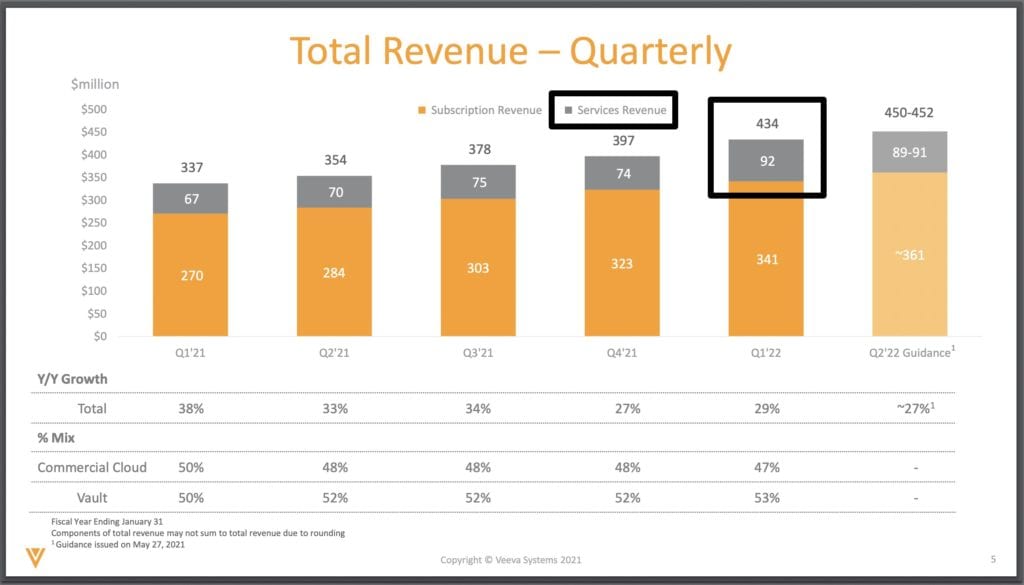
Veeva Systems is a quieter SaaS enterprise giant that if you sell bigger deals, and/or do vertical SaaS, it’s worth learning more about. CEO Peter Gassner is truly of the most impressive founders I’ve personally met and you can take a look at our deep dive from SaaStr Annual 2017 here not long after they’d IPO’d: One of many remarkable things about Veeva: it burned about $3m on the way to IPO. Yes, $3m. In basically one venture round and a bit of angel investing. And that’s with a sales-driven, enterprise model. Fast forward to today, they are growing 29% at $2 Billion in ARR! 5 Interesting Learnings: #1. Professional Services remains 20% of revenues, even at $2B in ARR. We’ve talked a lot about professional services over this series, and seen folks like Qualtrics and now Veeva sell them profitably, for up to 20% of revenues, and others in the enterprise try to minimize the services revenue and have partners do most of the heavy lifting. Salesforce and ServiceNow do the latter. Different approaches clearly work for different vendors. But it’s interesting to see that even at $2B in ARR, Veeva continues to “in source” professional services:
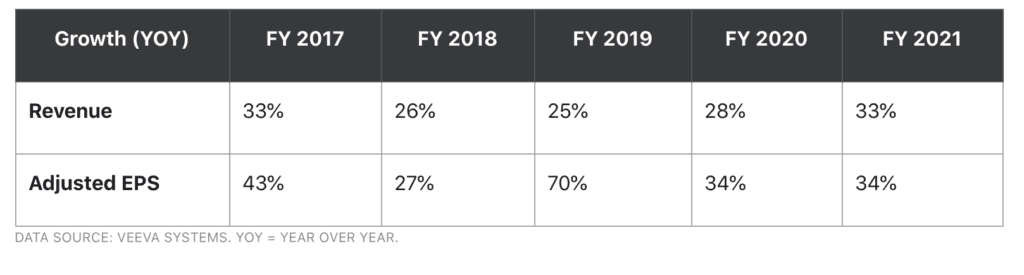
#2. Revenue has accelerated in 2021 — even at $2B in ARR. It’s incredible how many Cloud leaders today at $1B+ ARR are not just growing quickly, but accelerating. Veeva is another. They are growing than the 25%-28% rate in 2018-2020:
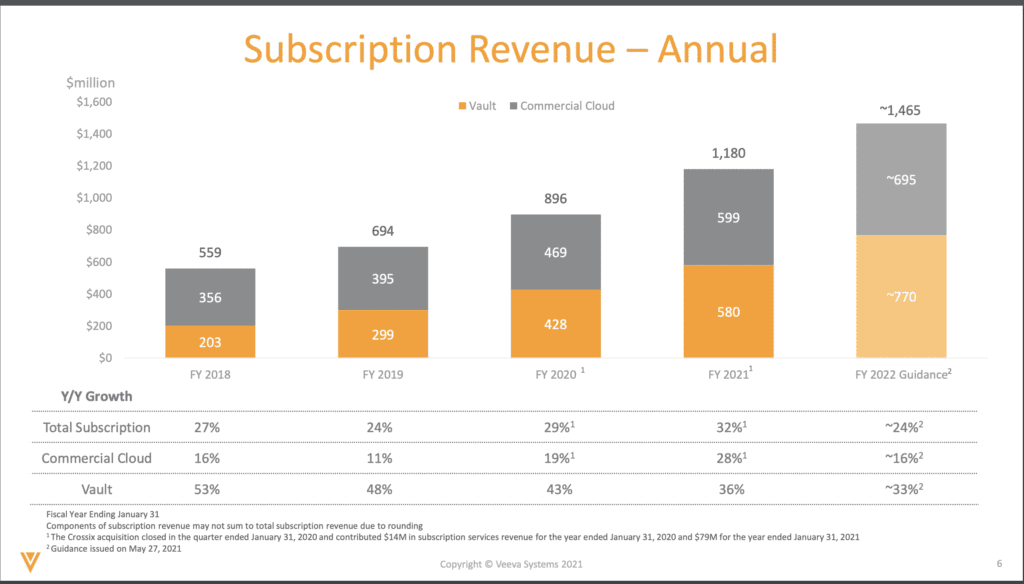
#3. A 2 Product line is key to growth at scale. Veeva has 2 core products — it’s CRM-like Commercial Cloud for pharma, biotech and more, and its Vault product for similar industries. For a while, it seemed like the Commercial Cloud product had matured and Vault would be the future growth engine. Interestingly, at $2B in ARR, both are now making equal contributions. Commercial Cloud growth reaccelerated, and Vault growth normalized:
#4. NRR still going up, at 124% today. We’ve talked a bit on SaaStr about how your NRR often can stay high forever, and Veeva is another great case study. NRR is at 124% today, and that’s up from 121% in 2021 and 122% in 2019. #5. 1,000 Customers at $2B in ARR. So about $200k ACV on average. And added 59 new customers last quarter. And many are well north of $1m ACV. Another reminder that the enterprise is far bigger than the Fortune 500 and Global 2000. Veeva already has 1,000 enterprise customers alone. And it’s adding 59 a quarter, so that’s another 250 new enterprise customers a year or so. A reminder there are 1000s of enterprise buyers for every leading product.
The post 5 Interesting Learnings from Veeva at $2 Billion in ARR appeared first on SaaStr.  |
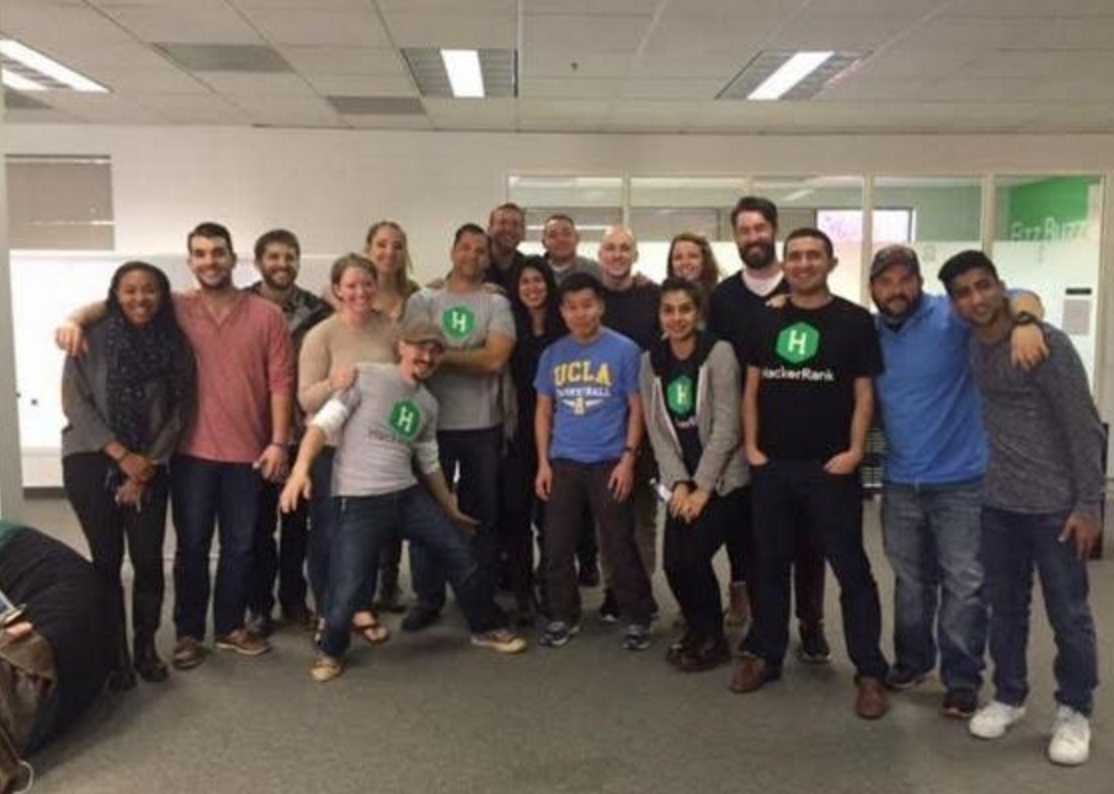
| How We Increased Sales Nearly 100% In One Quarter Posted: 09 Jun 2021 05:20 AM PDT A ways back, I asked Brendon Cassidy, VP of Sales at LinkedIn, Adobe Sign / EchoSign, and Talkdesk to put together his playbook for double sales. I thought it was a great checklist for all of us to take a look at. Brendon wrote this post about his learnings about how he doubled sales once again in one quarter (the story of how he did it for and with me is here) a ways back at HackerRank, where he served as Interim VP of Sales. But the list works just as well today and with others. You may be different from Khosla Ventures and YC-backed HackerRank, but take his 8 learnings and see if you are applying the same methodology if you are in the $1m-$10m ARR band. I think you’ll pick up at least one good idea or improvement. — Jason, ed. …. How We Increased Sales Nearly 100% In One Quarter at HackerRank – Brendon Cassidy For the past 18 months or so I had tracked the progress of a startup called HackerRank, and their founder Vivek Ravisankar, whom I met through a mutual friend. I thought Vivek was one of the smartest young founders in Silicon Valley. As importantly, he was truly a good guy. What I knew of HackerRank: a good startup that didn't yet have great sales execution.
The end result: In one quarter we nearly doubled new business and total bookings. In my book none of these changes required any particular genius. Common sense. Just an FYI: I've done some iteration of this 4 times in early stage startups. It's worked every time. Bottom line: the focus needs to be on simplifying at every turn, driving strong black and white themes, and hustling 24 hours a day, 7 days a week. And making some simple but important decisions Allright. Here is how we did it:
And that's it. HackerRank now acts, looks, and feels much more like a fast growth (even hypergrowth) SaaS company. They have a chance to win, and win big. However, the key to getting on the right path and sustaining it requires constant vigilance. You cannot lose your hustle. You cannot lose your edge. But better to have the issue of trying to sustain increased growth than not having it at all. (note: an updated SaaStr Classic case study)
The post How We Increased Sales Nearly 100% In One Quarter appeared first on SaaStr.  |
| What to Do When You Are Too Early To a New Market Posted: 08 Jun 2021 07:57 AM PDT
As a founder, I’ve been on both sides of market maturity. In my first start-up, we entered a very mature market that was basically a monopoly. That meant it was hard to break in, but once you did, the customers had big checkbooks. We closed $6m our first year (more on that here). It wasn’t easy, but once we had the break-out product the customers wanted — the cash was there. Because the market was mature and budgeted. The second time, at Adobe Sign / EchoSign, the market was way early when we entered. It was less than $1m in total size, vs. > $2.5B today. More on that here. But once the market finally grew, boy it got big. Not only is DocuSign on a tear, but Adobe Sign was Adobe’s fastest-growing product in 2020 and 2021, and even smaller players are worth hundreds of millions and more:
Some of us are intentional in which type of market we pick — mature and competitive, or new and emerging (and likely less competitive). Some of us really want to compete with a new entrant in a proven market, and explode like a Datadog. Others want to help reinvent or invent a newer space, like Snowflake or UiPath. But I think for most of us, we find a business problem we want to solve. And the state and the maturity of the market sort of ends up what it is.
So what do you do if you are way early? By that I mean, a market is there for your product, but it’s tiny today.
These aren’t magical solutions to the fact that if you’re early to market, your revenues will often be tiny in the early days. But have the confidence to see that your market will grow. And that if you can just get to $1m ARR, you’ll find a way to get to $2m ARR. Then $4m ARR. Then at least $10m ARR. And that’s enough. Enough to compound into something amazing.
The post What to Do When You Are Too Early To a New Market appeared first on SaaStr.  |
| New SaaStr Annual Speakers!! CEOs of Calendly, Y Combinator, Vimeo, President Shopify and More!! Posted: 08 Jun 2021 06:45 AM PDT We’re continuing to gear up for the 2021 SaaStr Annual in the SF Bay Area, Sept 27-29! Each week we’ll be adding more incredible speakers. This week we’ve added:
Join us!!! Grab final, 30% off early-ish bird tickets here!
The post New SaaStr Annual Speakers!! CEOs of Calendly, Y Combinator, Vimeo, President Shopify and More!! appeared first on SaaStr.  |
| In The Early Days, What You Think is a “Sales” Problem is More Likely a Marketing Problem Posted: 08 Jun 2021 05:08 AM PDT The other day I met with a great founder doing about $40k in MRR that wanted to raise some extra money to “make sales more repeatable.” Sounds good.
I started to dig in a bit to understand what this founder really meant though. At this rough stage ($20k-$80k or so MRR), usually most SaaS startups finally have a regular stream of leads — just not that many. 10 a month, 20, 100, whatever it is. Leads now come in regularly because at least something is working, there just aren’t a lot of them. Not enough to grow fast enough, but enough to grow regularly. So we dug into the math. This great start-up is closing about 5 new customers a month, and they want more. They want more “salespeople” and/or a magical VP of Sales to help them. But let’s dig into what’s really happening:
That’s actually kind of amazingly good — a 50% close rate, with a sales cycle of less than 30 days — for a vendor in a very crowded space, with well-established competitors and zero brand awareness, that spends $0 on marketing. So my advice was simple: you don’t have a sales problem. At least not yet. You have a marketing “problem”. The founders themselves can handle 10 qualified leads a month. Not only is that not very many calls, but in the early days, the founders are such experts in the product, its nuances, how to hack it, etc … you want them to keep selling, at least until it becomes > 25% of their time. 10 demos a month wasn’t yet > 25% of their time. Usually, in fact, hiring your first salespeople won’t really help in sales until there are enough leads that the founders just don’t have time. That’s probably 25+ qualified leads a month, potentially more. Once you are there — hire your first rep (ideally two, in fact, more on that here). But before that, a warm body that doesn’t know your product well isn’t really going to help. Instead, focus on hiring a head of demand gen. As we’ve discussed before, $500k in ARR is almost late for a head of demand gen. Have her help you go from 100 to 200 sign-ups a month. To work the funnel so those 50 MQLs turn into 25 SQLs, not 20. That’s where the leverage often is at this stage. More on this here. Later, when you have a surplus of leads, sales will help you sell more. And after that, in fact, it will all become a capacity and numbers game. But in the early days, it’s usually marketing to the rescue. Not some sales magician. (note: an updated SaaStr Classic post) The post In The Early Days, What You Think is a “Sales” Problem is More Likely a Marketing Problem appeared first on SaaStr.  |
 BeKind
 (@jasonlk)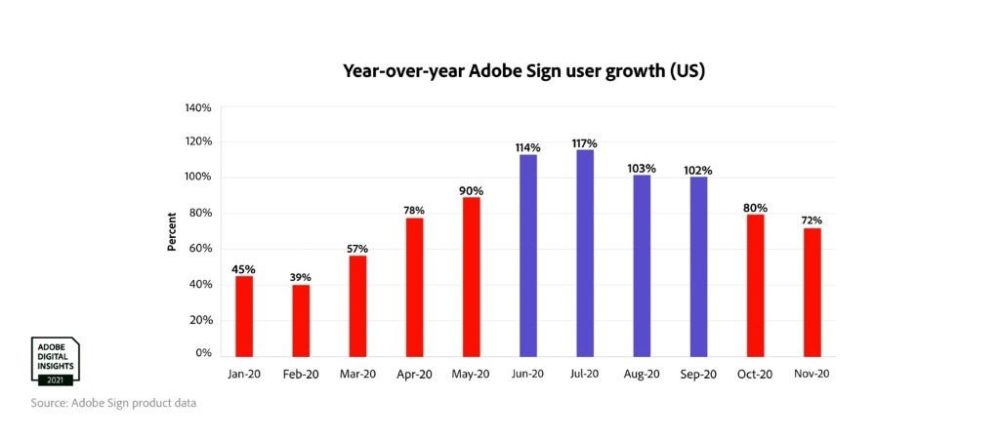

| You are subscribed to email updates from SaaStr. To stop receiving these emails, you may unsubscribe now. | Email delivery powered by Google |
| Google, 1600 Amphitheatre Parkway, Mountain View, CA 94043, United States | |



0 Yorumlar